Sudoku Tips: 12 Rules to Solve Faster Without Guessing
Use 12 practical Sudoku tips to solve faster without guessing: scan smarter, place singles, clean up notes, and spot common eliminations.
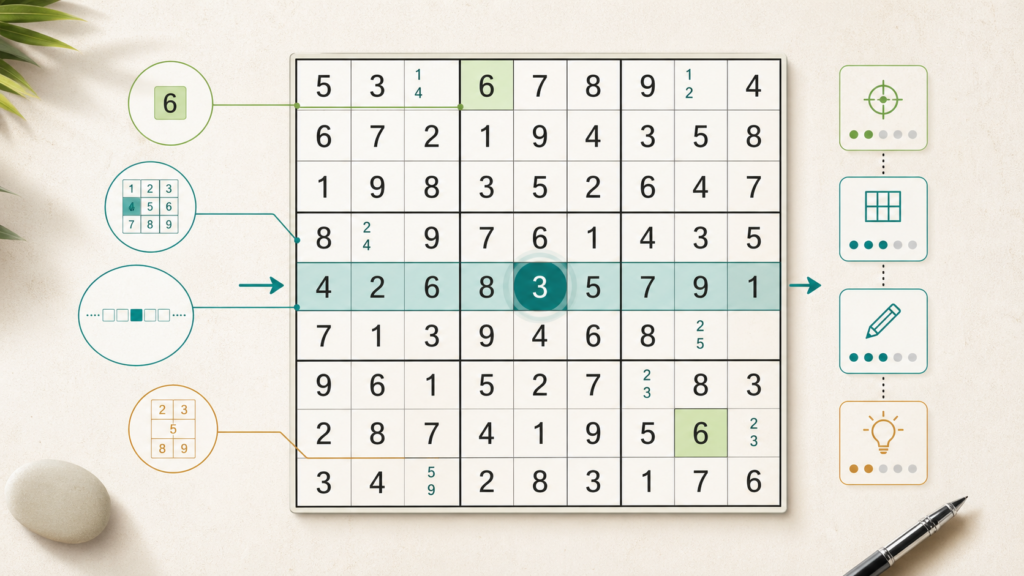
The best Sudoku tips help you solve with a repeatable routine: scan the tightest areas, place singles first, use notes carefully, and only move to pairs or eliminations when the easy progress is gone.
Practice one tip now Open an easy board, use notes, and practice one solving habit before adding the next.
Try these Sudoku tips on a fresh puzzle
Keep this guide open while you play Sudoku online in Pure Sudoku. Try one tip per puzzle, then build the full routine as your boards get harder.
Quick Answer: The Best Sudoku Tips
The best Sudoku tips are the habits you can repeat on every puzzle. Use this order before you hunt for advanced patterns:
- Start with rows, columns, and boxes that are almost complete.
- Look for naked singles before anything else.
- Use notes when the next move is not obvious.
- Find hidden singles inside each row, column, and 3×3 box.
- Update notes after every placement.
- Use pointing pairs, naked pairs, and hidden pairs when singles run out.
- Do not guess unless you are deliberately testing a separate puzzle-solving method.
12 Tips for Sudoku That Work on Real Puzzles
1. Start With the Fullest Areas
Rows, columns, and boxes with the fewest blanks give you the strongest restrictions. Before scanning the whole grid, check the most crowded units and ask which digits are missing.
2. Check Naked Singles First
A naked single is a cell with only one possible number. It is the safest move in Sudoku, so check for it before spending time on harder techniques. For a deeper walkthrough, read the naked single guide.
3. Add Notes Before the Grid Gets Messy
On easy puzzles, notes may be optional. On medium and hard puzzles, good notes reveal hidden singles, pairs, and eliminations. Use notes when scanning no longer gives an obvious placement.
4. Look for Hidden Singles
A hidden single appears when a digit can go in only one square inside a row, column, or box. The cell may have several candidates, but that digit is forced. Practice this with the hidden single guide.
5. Re-Scan After Every Placement
Every number changes one row, one column, and one box. Re-check those three areas immediately. Many follow-up moves appear right next to the number you just placed.
6. Keep Notes Clean
Outdated notes make a puzzle look harder than it is. After placing a number, remove that candidate from the same row, column, and box before moving on.
7. Use a Fixed Solving Order
Random scanning wastes energy. A reliable order is singles, hidden singles, box-line interactions, pairs, then advanced patterns. The full Sudoku strategy order gives you a repeatable checklist.
8. Learn a Few High-Value Eliminations
You do not need every named Sudoku pattern. Most improving players get the best return from pointing pairs, claiming, naked pairs, and hidden pairs.
9. Avoid Guessing When Progress Slows
Being stuck usually means a simple clue was missed, notes are stale, or the wrong unit is being scanned. Clean the board and restart from singles before guessing.
10. Match the Puzzle to Your Skill
If every puzzle feels chaotic, step down one difficulty. Easy and medium boards are where scanning, notes, and singles become automatic. Read Sudoku difficulty levels explained when choosing your next board.
11. Review Mistakes Instead of Racing Past Them
When a board goes wrong, pause and identify whether the mistake came from a missed rule, a bad note, or a rushed scan. That review turns one failed puzzle into better habits.
12. Practice One Habit Per Puzzle
Do not try to master every technique at once. On your next free Sudoku browser game, focus only on clean notes. On the next one, focus on hidden singles. Small practice goals build fast solves.
Pure Sudoku
CLEAN. SMART. ADDICTIVE.
Today's puzzle Today

Be the first to set a time today.
Prefer solo practice? Pick a difficulty to generate a fresh board instantly.
Pick the difficulty you want to race.
How do you want to play?
 00:00
00:00
 M: 0
M: 0
 81 remaining

Which Tip Should You Use First?
| If this happens | Use this tip | Why it helps |
|---|---|---|
| You do not know where to start | Scan the fullest rows, columns, and boxes | They have fewer possible digits. |
| You have several candidates in many cells | Look for hidden singles | A digit may be forced even when the cell has options. |
| You keep rechecking the same places | Use a fixed order | It prevents wasted scans. |
| Your notes feel confusing | Clean notes after every placement | Bad candidates hide real moves. |
| The puzzle stalls after singles | Try pairs or pointing moves | They remove candidates without guessing. |
A 10-Minute Sudoku Practice Routine
Minute 1: scan crowded units
Find the rows, columns, and boxes with the fewest blanks.
Minutes 2-4: place singles
Look for naked singles and hidden singles before adding more notes.
Minutes 5-7: clean candidates
Update notes in every affected row, column, and box.
Minutes 8-10: try one elimination
Check for pointing pairs or naked pairs only after the singles are gone.
Frequently Asked Questions
Tips for Sudoku FAQ
- What is the best tip for Sudoku beginners?
- Start with the fullest rows, columns, and 3×3 boxes, then check for singles before using advanced techniques.
- How do you solve Sudoku faster?
- Use the same solving order each time, keep notes clean, and practice on a consistent difficulty until singles and hidden singles become automatic.
- Should you use notes in Sudoku?
- Yes, especially on medium and hard puzzles. Notes help you find hidden singles, pairs, and eliminations without guessing.
- Is guessing a good Sudoku strategy?
- No. Standard Sudoku puzzles are designed to be solved with logic. If you feel stuck, clean your notes and restart your scan from the simplest moves.
- Where can I practice these Sudoku tips online?
- You can start a fresh Sudoku game in Pure Sudoku and focus on one habit per board.
Keep improving
Play Sudoku online
Keep the next step focused on a real Sudoku board.
Play Sudoku onlineSudoku solver
Keep the next step focused on a real Sudoku board.
Sudoku solverDaily Sudoku
Keep the next step focused on a real Sudoku board.
Daily SudokuPrintable Sudoku
Keep the next step focused on a real Sudoku board.
Printable SudokuKeep the Process Simple
The best Sudoku tips are not complicated. Scan tight areas, place singles, keep notes current, and move to eliminations only when the board asks for them. When you are ready to practice, open Pure Sudoku and solve one board with clean logic before you worry about speed.
Sudoku Tips FAQ
Practice one tip now Start a new puzzle and follow the same scan, notes, singles, and elimination order until it becomes automatic.
Turn the tips into a solving routine