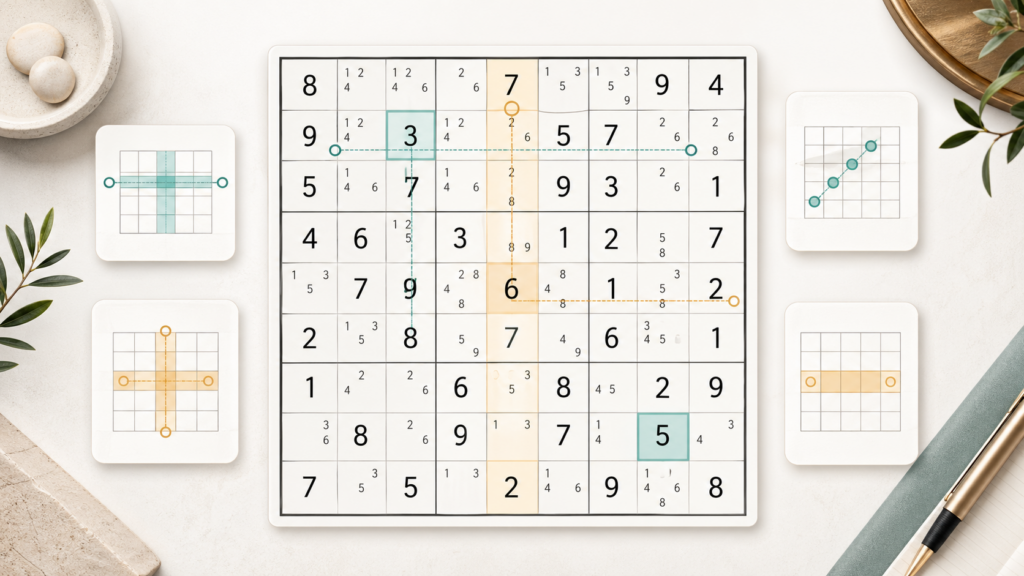
Sudoku Strategies: Step-by-Step Techniques to Solve Without Guessing

Learn the best Sudoku strategy order: singles, clean notes, pairs, pointing moves, and advanced patterns. Practice each technique on Pure Sudoku.

Published November 28, 2025 7 min read Updated April 11, 2026

Use this guide as a practical Sudoku strategy map: start with singles, add candidate eliminations when the grid stalls, then practice each move on a live board. If you want to apply the steps immediately, open Pure Sudoku and keep this page nearby while you solve.

Pure Sudoku

Practice these Sudoku strategies now

Start a fresh Sudoku game in your browser.

Best Sudoku Strategy Order

The best Sudoku strategy is not one trick. It is a repeatable order of checks that keeps you from guessing. Work through the puzzle in this sequence:

Sudoku solving strategy sequence

  1. Scan rows, columns, and boxes for missing digits.
  2. Place naked singles when a cell has only one possible number.
  3. Find hidden singles when a number has only one possible square in a unit.
  4. Add pencil marks only after easy placements slow down.
  5. Use naked pairs and hidden pairs to remove candidates.
  6. Use pointing pairs and claiming to connect boxes with rows or columns.
  7. Try X-Wing, Swordfish, XY-Wing, and coloring only after basic eliminations stall.
  8. Return to singles after every placement or elimination.

This order matches how most players improve: simple placements first, candidate cleanup second, advanced patterns last. It also makes online practice easier because every solve becomes a short diagnostic loop instead of a search for a magic technique.

Sudoku Techniques by Skill Level

Skill level Technique Use it when Practice link
Beginner Naked single A cell has only one valid candidate left. Start a fresh Sudoku game
Beginner Hidden single A digit appears in only one cell in a row, column, or box. Hidden single guide
Intermediate Naked pair Two cells in one unit share the same two candidates. Naked pair guide
Intermediate Pointing pair A candidate inside a box is locked to one row or column. Pointing pairs guide
Advanced X-Wing A candidate forms a rectangle across two rows and two columns. X-Wing guide
Advanced XY-Wing Three bi-value cells create a shared candidate elimination. XY-Wing guide

Start With the Fundamentals

Every strong Sudoku solve starts with the same question: what can be placed with certainty right now? Before you write full notes, scan each row, column, and 3×3 box for missing digits. This finds easy placements and prevents a crowded board from hiding simple logic.

Technique
Beginner

Naked singles

If a square can contain only one number after checking its row, column, and box, place that number and rescan nearby units.

Technique
Beginner

Hidden singles

If a number can go in only one square within a row, column, or box, place it even when that square has other pencil marks.

Crosshatching Method

Pick one digit, such as 5. Look across the rows and columns where 5 already appears, then eliminate those lines inside each 3×3 box. If only one square remains in a box, that square must be 5. Crosshatching is especially useful on easy and medium puzzles because it trains your eyes to find hidden singles before you depend on notes.

Use Candidate Strategies When Singles Stop

When the board stops giving obvious placements, add pencil marks. The goal is not to fill every square with clutter. The goal is to make eliminations visible.

Technique
Intermediate

Naked pairs and triples

When two or three cells in a unit contain the same two or three candidates, those digits are locked there. Remove them from the rest of the unit.

Technique
Intermediate

Pointing and claiming

When a candidate is confined to one row or column inside a box, remove that candidate from the same row or column outside the box.

After each candidate elimination, pause and rescan for singles. Many Sudoku puzzles break open because one cleaned-up note creates a new hidden single.

Advanced Sudoku Strategies

Hard and expert puzzles often require pattern-based eliminations. Use these only after the beginner and intermediate checks stop producing progress.

X-Wing

An X-Wing appears when one candidate can occupy the same two columns in two different rows, or the same two rows in two different columns. Those four cells form a rectangle. If the candidate must sit in opposite corners of that rectangle, you can remove it from the other cells in those aligned rows or columns.

Swordfish

Swordfish extends the same logic to three rows and three columns. It is slower to spot, so check X-Wings first. If you are practicing fish patterns, use a clean board and focus on one digit at a time.

XY-Wing

An XY-Wing uses a pivot cell with two candidates and two wing cells that each share one candidate with the pivot. When both wings see a common candidate, cells that see both wings cannot contain that shared number.

Simple Coloring

Coloring helps when a candidate appears in linked pairs across the grid. Mark alternating possibilities with two colors. If one color creates a contradiction, the other color is true. Use coloring sparingly and verify every link.

Practice the Strategy, Not Just the Puzzle

For direct practice, open the free Sudoku browser game, choose a comfortable difficulty, and solve with one focus per round. For example, spend one puzzle looking only for hidden singles, then the next puzzle looking for pairs after singles dry up.

Pure Sudoku

CLEAN. SMART. ADDICTIVE.

Daily Challenge

Today's puzzle Today

Loading...

    Be the first to set a time today.

    Prefer solo practice? Pick a difficulty to generate a fresh board instantly.

    Medium
    Mistakes: 0
    00:00
    â„šī¸
    Tap a cell to begin.

    Strategy Deep Dives

    Use these supporting guides when you want a slower walkthrough of one tactic:

    Common Sudoku Strategy Mistakes

    • Guessing too early: If you guess before rebuilding notes, you may spend the rest of the puzzle repairing a false path.
    • Skipping the rescan: Every placement can create new singles in nearby units.
    • Writing too many notes too soon: Full notes help later, but early clutter can hide simple placements.
    • Looking for advanced patterns first: X-Wing and XY-Wing are useful, but they should not replace fundamentals.

    7-Day Sudoku Strategy Practice Plan

    Day Focus Assignment
    1 Scanning Play one easy puzzle and list every row, column, or box scan that creates a placement.
    2 Hidden singles Play one medium puzzle and pause after every placement to find hidden singles.
    3 Clean notes Use pencil marks only after singles slow down. Remove candidates immediately after each placement.
    4 Pairs Find at least one naked pair or hidden pair before using any hint.
    5 Pointing moves Check every 3×3 box for candidates locked to a single row or column.
    6 Advanced scan Try one hard puzzle and look for X-Wing patterns on one digit at a time.
    7 Review Replay a puzzle you struggled with and note which strategy unlocked it.

    Sudoku Strategy FAQ

    Frequently Asked Questions

    What is the best strategy for Sudoku?

    The best Sudoku strategy is to scan for singles first, add candidates only when needed, use pairs and pointing moves for eliminations, and try advanced patterns only after simpler logic stalls.

    How do you solve Sudoku without guessing?

    Use only placements and eliminations that follow from rows, columns, boxes, and candidate patterns. If you cannot prove a move, rebuild notes and rescan instead of guessing.

    Which Sudoku technique should beginners learn first?

    Beginners should learn naked singles, hidden singles, and crosshatching first. These techniques solve many easy puzzles and prepare you for candidate-based strategies.

    When should I use advanced Sudoku strategies?

    Use advanced strategies after singles, pairs, triples, pointing, and claiming stop producing progress. Hard puzzles may need X-Wing, Swordfish, XY-Wing, or coloring.

    Keep practicing with the main tools: play Sudoku online, try the daily Sudoku puzzle, check a stuck board with the Sudoku solver, or print extra boards from printable Sudoku.