Sudoku Number Puzzle Games: From Basics to Advanced Wins
Sudoku number puzzle games include classic 9×9 grids, minis, irregulars, and themed apps. To improve fast, pair a quality platform with a disciplined solve loop, advanced techniques, drills, and light logging. This guide gives you the full system so you can finish puzzles logically—no guessing—on desktop or mobile.
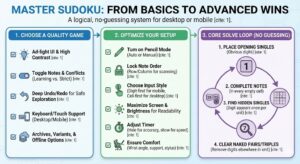
Pick a Quality Game
- Ad-light UI with high contrast.
- Notes + conflicts you can toggle for learning vs. strict play.
- Undo/redo depth for safe exploration.
- Keyboard/touch support: Arrows + numbers on desktop; digit-first on mobile.
- Archives/variants: Daily drops, 4×4/6×6, hard sets.
- Offline option: Cached puzzles or downloadable packs.
Set Up Before You Start
- Turn on pencil mode first: Decide whether you want auto-notes or manual; stay consistent per puzzle.
- Lock a note order: Write candidates in row/column order (123/456/789) so you can scan visually.
- Choose input style: Digit-first on mobile to avoid mis-taps; cell-first on desktop for speed.
- Full-screen + brightness: Reduce distractions and make small candidates readable.
- Timer strategy: Hide the timer until accuracy is steady; show it only for specific speed drills.
- Comfort: Neutral wrist angle, chair support, and a stylus on tablets to reduce fatigue.
Core Solve Loop (No Guessing)
- Opening singles: Place obvious digits.
- Complete notes: Candidates in every empty cell.
- Hidden singles: If a candidate appears once per unit, place it.
- Naked pairs/triples: Clear those digits elsewhere in the unit.
- Pointing pairs/box-line: Constrain candidates across boxes and lines.
- Loop: Re-scan after each elimination; finish with a duplicate check.
This loop solves most easy/medium games and prepares hards for advanced moves. Work from boxes first to reveal locked candidates, then rows/columns.
Advanced Techniques
- X-Wing: Two rows share candidate columns; eliminate elsewhere. Use when a single digit clogs two lines.
- XY/XYZ-Wing: Pivot plus wings clear shared candidates. Great when a cell has exactly two notes.
- Simple coloring: Two-color a candidate chain; contradictions force eliminations. Start with the most frequent candidate.
- Remote pairs: Chain identical pairs to remove candidates where chains meet; powerful in late midgame.
- Finned fish: A sneaky cousin of X-Wing; if one fin sits in the shared box, you can still eliminate other sightings.
- Contradiction check: Tentatively place one note, push two steps forward, and undo if a duplicate appears.
Learn one technique per two-day block. Label it in your log whenever it solved or pruned candidates so you see real impact.
Example 20-Minute Solve
- 0–3 minutes: Singles + notes.
- 3–8 minutes: Hidden singles; first pairs; pointing pairs.
- 8–15 minutes: X-Wing scan; test an XY-Wing; short coloring chain if needed.
- 15–20 minutes: Finish two-blank lines; duplicate check.
If you stall at minute 10, rebuild one box’s notes, then run a digit sweep on 1 and 9—they often reveal box-line locks.
Decision Tree for Tough Spots
- Refresh notes in the busiest box; mis-notes are the top blocker.
- Run a digit sweep on the most common candidate; look for two-per-row patterns.
- Check box-line locks (pointing pairs) before jumping to wings.
- Scan for a two-note pivot to attempt XY-Wing or a short color chain.
- Undo to last certainty, clear the noisy region, and re-note it cleanly.
Use a five-minute cap for this rescue loop; if nothing moves, switch puzzles or take a 90-second break.
One-Week Accelerator
- Days 1–2: Two mediums daily; conflicts on; log errors.
- Days 3–4: One hard; deliberate pointing pairs/naked pairs.
- Day 5: Replay the hardest; aim for fewer undos.
- Days 6–7: One medium timed, one untimed; compare accuracy.
Two-Week Advanced Plan
- Days 8–10: X-Wing on one digit per puzzle; note success.
- Day 11: XY/XYZ-Wing practice on a saved hard.
- Day 12: Variant day (mini/killer/irregular) to refresh.
- Days 13–14: Two hards—one accuracy (conflicts on), one strict (conflicts off, timer hidden).
30-Day Mastery Plan
- Week 1: Accuracy focus. Clean notes, zero guesses, conflict checks on, daily log.
- Week 2: Pattern focus. Require one advanced technique per puzzle (even if slow).
- Week 3: Speed focus. Hide timer until midgame; add two short timed runs (8–12 minutes) plus one relaxed solve.
- Week 4: Variation focus. Mix one 6×6, one irregular/jigsaw, and two hards; finish with a strict run (no undo, no hints).
Drills for Speed and Accuracy
- Digit sweep: Two minutes per digit hunting singles/pairs.
- Pairs hunt: Clear naked pairs in every box.
- Box-first pass: Focus on box-line interactions for one loop.
- Endgame drill: Practice finishing two-blank rows with a duplicate scan.
- Coloring reps: Pick one candidate, color its chain, and try to force an elimination even on an easy puzzle.
- Five-move rewind: Play five moves, undo all, and replay them cleaner to cement patterns.
Endgame and Error Recovery
- Two-blank row method: Cross-eliminate using column and box; never guess—one candidate will conflict.
- Duplicate sweep: Hide notes briefly and scan for visual repeats in each row/column.
- Conflict isolation: If an error appears, undo to the last confirmed single, clear notes in that region, and re-note.
- Proof pass: Before submitting, check all 3×3 boxes for digits 1–9 exactly once; it takes under 60 seconds and saves streaks.
Device Tips
- Desktop: Full-screen; arrows + numbers; space/shift for notes.
- Mobile: Digit-first taps; zoom; large buttons; hide timer if stressful.
- Tablet: Landscape mode; stylus for precision.
- Controller/keyboard remap: Map numbers to a compact block (1–9) and use WASD/arrow keys for motion to reduce strain.
Comfort and Accessibility
- High-contrast theme with bold candidate font and thicker grid lines.
- Reduce motion if animations distract; keep only highlight-on-select.
- Text size: Increase candidate font until you can read without squinting, even if fewer cells fit on screen.
- Short breaks: Stand up every 20 minutes; cognitive refresh improves pattern spotting.
- Noise control: Use calm sounds or silence; avoid ticking timers unless training for speed.
Daily Checklist and Logging Template
- Warm-up: 60-second digit sweep on an easy grid.
- Main solve: One medium or hard with conflicts on for accuracy, off for strict runs.
- Technique rep: Intentionally find one wing, fish, or color chain.
- Proof + duplicate sweep: End every puzzle with this habit.
- Log: Capture time, errors, what unlocked the grid, and one improvement idea.
Date:
Puzzle: (easy/medium/hard) | Platform: (web/app/offline)
Time: ____  Errors/undos: ____  Conflicts: on/off
Big unlock: (hidden single / pointing pair / X-Wing / coloring / wing)
What I missed first pass:
One change for next run:
Metrics to Track Weekly
- Average time by difficulty.
- Undo/conflict count: Lower = cleaner logic.
- Techniques applied: Singles, pairs, pointing pairs, X-Wing, XY-Wing, coloring.
- Clean solves: Zero-error runs.
- Note rewrites: Fewer rewrites indicate better hygiene.
- Streak length: Track days played to reinforce habit.
Variant Cross-Training
- Mini (4×4 or 6×6): Speed your scanning; great for five-minute drills.
- Jigsaw/irregular: Strengthen spatial awareness for box-line logic.
- Killer/thermo: Practice arithmetic constraints and long chains without guessing.
- Diagonal/anti-knight: Forces more candidate pruning; transfer the discipline back to classic grids.
- Samurai: Manage multiple overlapping grids to improve note hygiene.
Pick the Right Difficulty Each Day
Match the puzzle to your energy and goal so you keep momentum:
- Low-energy days: One easy or mini plus a five-minute digit sweep; focus on clean notes and a perfect streak.
- Skill-building days: One medium where you must log a pointing pair, then replay the same grid stricter.
- Challenge days: One hard with timer hidden until midgame; stop if you guess twice and switch to a medium to finish strong.
- Speed days: Two mediums back-to-back; compare times and note where you hesitated.
- Recovery days: Replay a recent loss, identify the missed lock, and write one sentence on how to spot it earlier.
Community and Friendly Competition
- Daily leaderboards: Race your own ghost time instead of strangers to reduce pressure.
- Share screenshots: Post clean solves or interesting wings in a chat; explaining a technique reinforces it.
- Micro-challenges: With a friend, agree to find one X-Wing today or hit zero undos; small bets keep habits sticky.
- Teach once a week: Show someone the core loop; teaching exposes your fuzzy spots so you can tighten them.
Offline and Travel Setup
- Download a pack: PDF or app pack of 20–50 puzzles in mixed difficulties.
- Print double-sided: Leave wide margins for notes; carry a 0.5 mm pencil and eraser.
- Offline app mode: Pre-load 10 puzzles before flights; keep battery saver on by dimming the screen.
- Mini emergencies: Store a 6×6 sheet for five-minute breaks; it keeps the streak alive.
Case Study: Cutting Time in Half
Amira played Sudoku number puzzle games casually at 18–20 minutes per medium. She kept losing streaks from duplicate errors. For two weeks she logged every solve, rewrote cluttered boxes, and forced one advanced move per day. By day 10 her note rewrites dropped from six to two per puzzle, conflicts fell to zero, and her average time slid to 10:45. The biggest gains came from a simple digit sweep habit and ending every grid with a proof pass.
FAQs
Do I need an account? Many games let you play instantly; accounts help track streaks.
Is guessing required? No—rebuild notes and apply advanced tools.
Mobile or desktop? Desktop is fastest with keys; mobile works with digit-first and zoom.
Can I play offline? Yes—cache puzzles or download packs.
What’s a good goal time? Beat your own average; accuracy first.
How do I stay motivated? Keep a visible streak count, rotate variants weekly, and save your fastest board screenshots.
Start Your Next Number Puzzle
Open your favorite grid, toggle notes, and run the scan-notes-eliminate loop. With solid fundamentals, deliberate drills, and a clean platform, Sudoku number puzzle games become a daily, rewarding habit that sharpens logic without guessing. Track your progress, celebrate clean solves, and add one new technique each week to keep the game fresh.