Sudoku Strategy Hub: Techniques to Solve Without Guessing
A practical Sudoku strategy hub: learn the solving order from singles and notes to pairs, box-line reductions, X-Wing, XY-Wing, and harder techniques.
Want a better break than more reading?
Open a fresh Sudoku grid, keep the rules simple, and turn this article into actual practice.
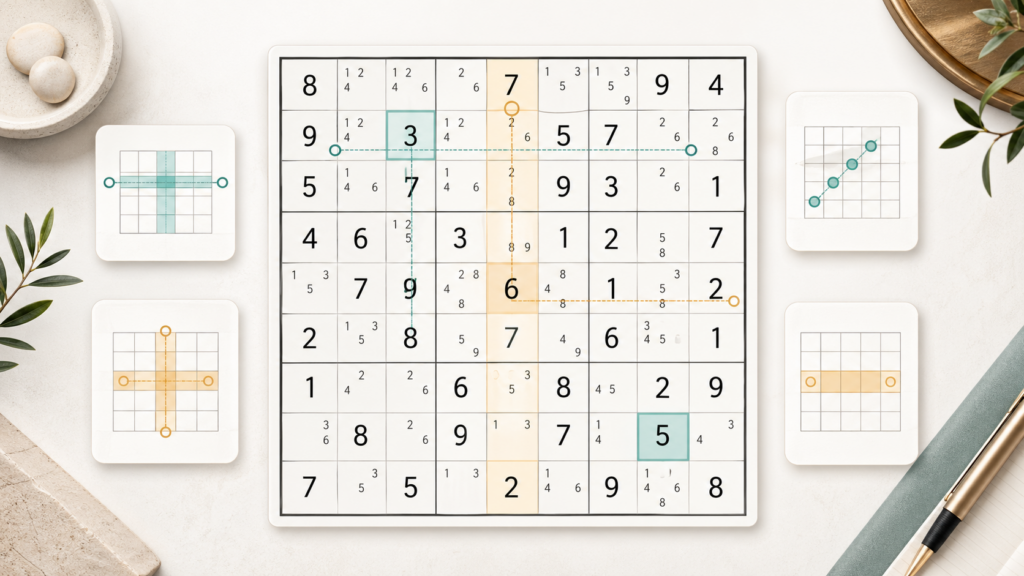
Get the iPhone App →Use this Sudoku strategy hub as an order of operations: scan for singles, add candidates only when needed, clean impossible numbers, then move through pairs, triples, box-line reductions, and advanced patterns before guessing.
If you searched for Sudoku strategy, Sudoku techniques, Sudoku tactics, or Sudoku methods, start here. The goal is not to memorize every named pattern at once. The goal is to know what to check next and which guide to open when the grid stalls.
Play free Sudoku online on Pure Sudoku
Sudoku strategy order
- Full houses: fill a row, column, or box with only one empty cell.
- Naked singles: place a number when a cell has only one possible value.
- Hidden singles: place a number when it has only one possible position in a row, column, or box.
- Candidate notes: add pencil marks only when basic scanning slows down.
- Locked candidates: remove candidates when a number is forced into one row or column inside a box.
- Naked and hidden pairs: use two-cell patterns to clean extra candidates.
- Triples: extend pair logic when three cells share three values.
- X-Wing and fish patterns: use row/column alignment when ordinary candidate cleanup is not enough.
Sudoku strategy hub by level
| Level | Learn this next | Practice |
|---|---|---|
| Beginner | How to play Sudoku, singles, clean scanning | Easy Sudoku |
| Early intermediate | Naked pairs, hidden singles, candidate cleanup | Medium Sudoku |
| Hard puzzles | Locked candidates, pairs, triples, box-line reductions | Hard Sudoku |
| Advanced | X-Wing, XY-Wing, Swordfish | Expert Sudoku |
Beginner strategies
Beginners should repeat three checks: rows with many numbers, columns with many numbers, and boxes with many numbers. Do not fill every candidate at the start. Too many notes can hide easy placements.
Intermediate strategies
Once singles slow down, use notes to find locked candidates, naked pairs, hidden pairs, and triples. These patterns remove possibilities rather than placing a number immediately, so they require a little patience.
Advanced strategies
Advanced puzzles may require X-Wing, Swordfish, XY-Wing, unique rectangles, or coloring. Learn them after your candidate notation is reliable; otherwise the hard part becomes reading your own notes.
Technique guides
Practice path
- How to play Sudoku
- Medium Sudoku practice
- Hard Sudoku practice
- Sudoku tips for beginners
- Average Sudoku time by difficulty
FAQ
What is the best Sudoku strategy?
The best strategy is a repeatable order: singles first, candidates second, eliminations third, advanced patterns last.
Should I guess in Sudoku?
Try not to. A well-made Sudoku has a logical path. Guessing can work, but it teaches less and makes mistakes harder to diagnose.
What technique should I learn after singles?
Learn locked candidates and naked pairs. They appear often on medium and hard puzzles.
Get a better Sudoku habit in your inbox
A quick daily puzzle reminder, streak motivation, and the occasional useful PS News update.