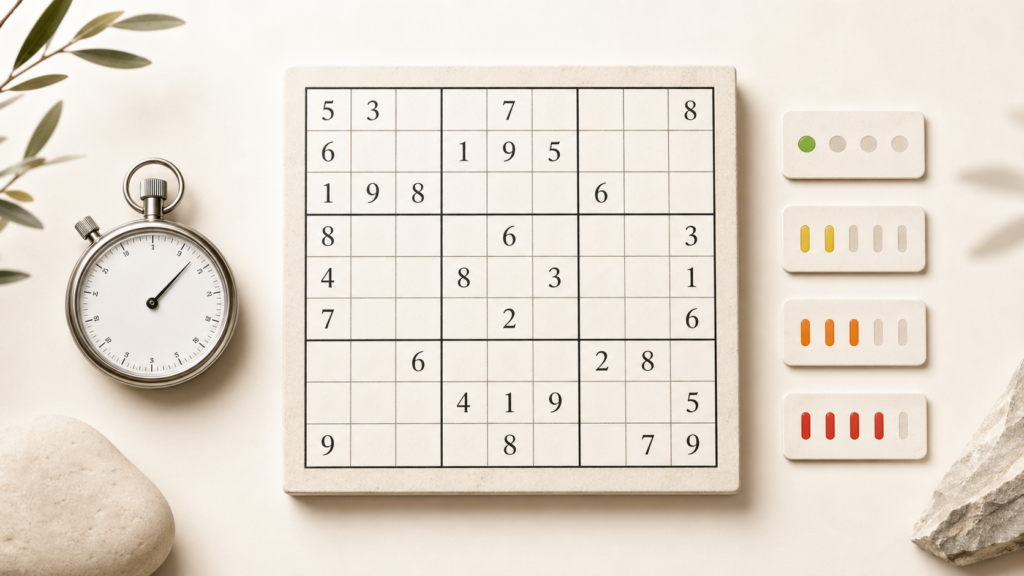
How Long Should a Sudoku Puzzle Take? Times by Difficulty
See realistic Sudoku solve times by difficulty, what counts as a good time, and how to get faster without guessing.
How long should a Sudoku puzzle take? For most everyday players, an easy Sudoku takes about 5 to 15 minutes, a medium Sudoku takes 15 to 30 minutes, and a hard Sudoku can take 30 to 60 minutes or more. The useful benchmark is not the fastest possible time. It is whether you can finish with clean logic and fewer mistakes.
If you want a fair comparison, open a fresh grid in the same format each time. You can play Sudoku online in Pure Sudoku, time one puzzle, then compare your result against the table below.
Sudoku Timing Benchmark
Time one puzzle in Pure Sudoku
Start with an easy grid, solve without guessing, then compare your result against the difficulty ranges in this guide.
Quick Answer: Normal Sudoku Solve Times
A normal Sudoku solve time depends on difficulty and experience. Use these ranges as practical benchmarks, not strict rules:
- Easy Sudoku: 5 to 15 minutes for many casual players; 10 to 20 minutes for newer beginners.
- Medium Sudoku: 15 to 30 minutes for regular players.
- Hard Sudoku: 30 to 60 minutes or more, especially if notes and intermediate techniques are needed.
- Expert Sudoku: often 45 minutes or longer unless you already know advanced patterns.
Average Sudoku Solve Time by Difficulty
This table uses editorial benchmark ranges for casual online and newspaper-style Sudoku. There is no single official global standard for casual Sudoku time because apps grade puzzles differently.
| Difficulty | Beginner | Regular player | Experienced solver |
|---|---|---|---|
| Easy | 10 to 20 minutes | 5 to 12 minutes | 3 to 8 minutes |
| Medium | 20 to 40 minutes | 15 to 30 minutes | 8 to 18 minutes |
| Hard | 35 to 60+ minutes | 25 to 45 minutes | 15 to 35 minutes |
| Expert or very hard | Often unfinished at first | 45 to 90+ minutes | 25 to 60 minutes |
What Is a Good Sudoku Time?
A good Sudoku time is a finish that matches the puzzle difficulty and still uses logic. For easy Sudoku, finishing under 10 minutes is a strong casual pace. For medium Sudoku, under 20 to 25 minutes is solid. For hard Sudoku, an accurate finish without guessing is already a good result.
If you are making fewer mistakes and solving similar puzzles a little faster over time, your timing is improving. A slow, clean solve is better practice than a fast solve that depends on guesses.
How Long Should Sudoku Take for Beginners?
Beginners often take 10 to 20 minutes on easy puzzles and 30 minutes or more on medium puzzles. That is normal. You are learning the rules, scanning routine, note-taking, and mistake checking at the same time.
Use this beginner checklist before worrying about the timer:
- You can finish easy puzzles without random guesses.
- You can explain why each placed number belongs there.
- You notice contradictions before they spread across the board.
- You use a repeatable routine instead of staring at the whole grid.
If the rules still feel new, start with how to play Sudoku, then come back to this timing guide.
Why Sudoku Times Vary So Much
Difficulty labels are not universal
One app’s medium puzzle may feel like another app’s hard puzzle. Difficulty depends on the solving logic required, not just the number of starting clues. For a deeper explanation, read Sudoku difficulty levels explained.
Your solving method changes the clock
Fast solvers usually waste fewer scans. They check rows, columns, and boxes in a consistent order, place forced moves first, and use notes when the puzzle gets tight. Build that routine with how to scan Sudoku and how to use notes in Sudoku.
Paper, mobile, and desktop times are different
Auto-checking, candidate notes, highlighting, keyboard input, and screen size all change solving speed. Compare your times in the same format when possible. A paper time and a browser-game time are not always measuring the same thing.
Practice: Time a Fresh Puzzle
Pick one difficulty, solve one grid without guessing, and write down your time. Then play the same difficulty again tomorrow. Pure Sudoku is a free Sudoku browser game, so you can repeat the test without setup.
Pure Sudoku
CLEAN. SMART. ADDICTIVE.
Today's puzzle Today
Be the first to set a time today.
Prefer solo practice? Pick a difficulty to generate a fresh board instantly.
Pick the difficulty you want to race.
How do you want to play?
How to Get Faster Without Rushing
1. Start with forced moves
Look for full houses, naked singles, and obvious hidden singles before trying anything advanced. Easy placements often unlock several more placements.
2. Scan in a fixed order
Use the same sequence every puzzle: boxes, rows, columns, then repeat after each placement. A repeatable pattern reduces wasted searching.
3. Recheck affected houses immediately
Every placed number changes one row, one column, and one box. Rechecking those areas right away is often faster than jumping elsewhere.
4. Use notes when the puzzle gets tight
Notes can feel slower at first, but clean notes usually save time on medium and hard puzzles. They reduce repeated checking and expose hidden singles.
5. Fix mistakes before chasing speed
If contradictions are costing you time, work on accuracy first. Review common Sudoku mistakes for beginners before trying to beat the clock.
When a Slow Sudoku Solve Is a Good Sign
A slower solve can mean your process is getting better. This happens when you stop guessing, start using notes correctly, or verify placements more carefully. The clock may get worse for a few puzzles before your new habits become faster.
That tradeoff is worth it. Better logic creates speed later.
Timing Goals That Make Sense
- Easy: finish cleanly first, then work toward 10 minutes or less.
- Medium: aim for consistent finishes under 25 minutes.
- Hard: aim to finish logically before caring about speed.
- Daily practice: track one difficulty for a week instead of switching levels every game.
When you want a repeatable daily benchmark, use Daily Sudoku or start a fresh grid on Pure Sudoku.
FAQ: Sudoku Solve Times
Sudoku Solve Time FAQ
- How long should an easy Sudoku take?
- For many casual players, an easy Sudoku takes 5 to 15 minutes. Beginners often take 10 to 20 minutes while they learn scanning and clean placement habits.
- How long should a medium Sudoku take?
- A medium Sudoku often takes 15 to 30 minutes for regular players. If you are new to notes, 30 to 40 minutes can still be normal.
- How long should a hard Sudoku take?
- A hard Sudoku can take 30 minutes to an hour or more. The important benchmark is whether you can finish logically without guessing.
- What is a good Sudoku time?
- A good Sudoku time depends on the difficulty. Under 10 minutes is strong for easy puzzles, under 20 to 25 minutes is solid for medium puzzles, and any accurate hard solve is a good result.
- Why do Sudoku apps show different solve times?
- Apps use different difficulty systems, input controls, highlighting, notes, hints, and mistake settings. Compare times within the same app or format for a fair benchmark.
Keep practicing
Play Sudoku online
Keep the next step focused on a real Sudoku board.
Play Sudoku onlineDaily Sudoku
Keep the next step focused on a real Sudoku board.
Daily SudokuSudoku strategies
Keep the next step focused on a real Sudoku board.
Sudoku strategiesPrintable Sudoku
Keep the next step focused on a real Sudoku board.
Printable SudokuBottom Line
How long should a Sudoku puzzle take depends on difficulty, experience, and the solving tools you use. Easy puzzles often take 5 to 15 minutes, medium puzzles 15 to 30 minutes, and hard puzzles 30 minutes or more.
Ready to test your pace? Start a fresh Sudoku game, solve cleanly, and use your next result as the benchmark to beat.