NY Sudoku Hard Alternative: Newspaper-Style Strategy
Looking for NY Sudoku Hard? Use a clean hard Sudoku board and a newspaper-style strategy loop for notes, pairs, box-line logic, and X-Wing practice.
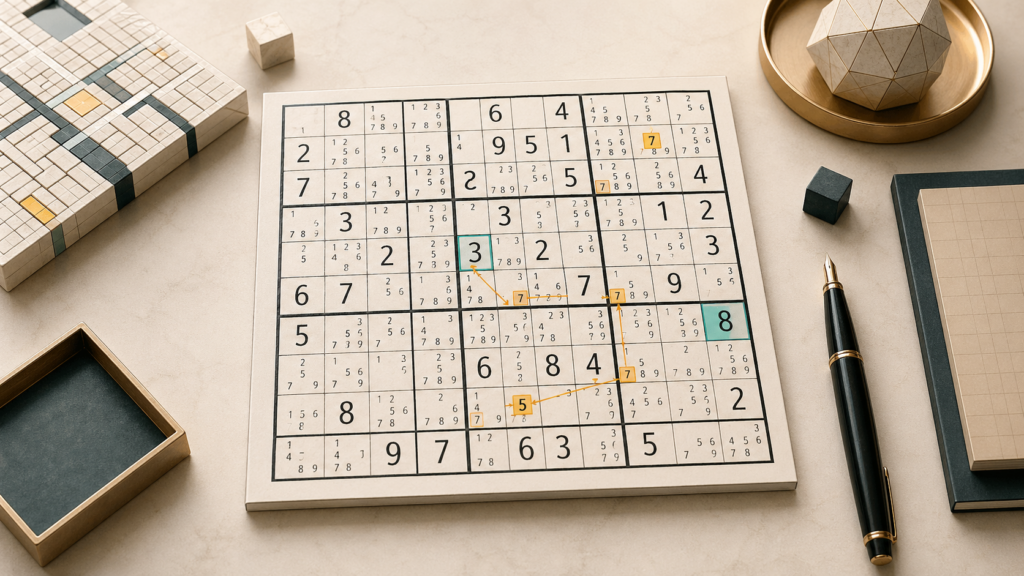
Want a better break than more reading?
Open a fresh Sudoku grid, keep the rules simple, and turn this article into actual practice.
Get the iPhone App →NY Sudoku Hard and other tough newspaper-style grids reward disciplined notes, careful scanning, and advanced basics like pairs, triples, pointing pairs, and box-line reductions. Use this strategy guide to keep solving without guessing.
Hard Sudoku practice Practice dense notes and advanced basics on a hard puzzle, then return to the guide when the grid stalls.
Train for hard Sudoku with a live board
Know Your Hard Puzzle Traits
- Moderate givens (often low 20s): Enough anchors, but lots of candidate work.
- Requires advanced basics: Hidden pairs/triples, pointing pairs, and box-line reductions.
- Occasional advanced moves: X-Wing or XY-Wing to break mid-game logjams.
- Precise endgames: Two-blank lines and careful duplicate checks.
Set Up a Clean Play Environment
- Ad-light interface: Distraction-free for long concentration.
- Fast notes: Quick pencil toggle; legible candidates.
- Conflict controls: On while learning; off for strict practice.
- Keyboard or digit-first: Choose the fastest input style for your device.
Core Hard-Puzzle Loop
- Opening singles: Stabilize the grid.
- Full candidates: Notes in every empty cell.
- Hidden singles: Place digits that appear once per unit.
- Naked/hidden pairs and triples: Thin candidate sets.
- Pointing pairs / box-line: Remove candidates across boxes and lines.
- Loop back: Re-scan for singles after each elimination.
This solves many “hard” New York grids; others need a light touch of advanced logic.
Advanced Tools for New York Hard
- X-Wing: Two-by-two candidate alignment across rows/columns for eliminations.
- XY-Wing: Pivot (a,b) connected to wings (a,c) and (b,c); eliminate c where both wings see.
- Simple coloring: Two-color a candidate chain to spot contradictions and forced placements.
Use one advanced tool at a time; verify each link.
Example 18-Minute New York Hard Solve
- 0–3 minutes: Singles + complete notes.
- 3–8 minutes: Hidden singles; naked pairs; first pointing pairs.
- 8–14 minutes: X-Wing scan on one digit; test XY-Wing if bivalue cells appear.
- 14–18 minutes: Finish with two-blank lines; final duplicate scan.
One-Week Hard Builder
- Days 1–2: Two mediums + one hard; focus on clean notes.
- Days 3–4: One hard; practice pointing pairs and naked pairs deliberately.
- Day 5: Replay the toughest hard; reduce undos and time.
- Days 6–7: Add an X-Wing or XY-Wing on purpose; log where it worked.
Two-Week Extension
- Days 8–10: One hard daily; apply one advanced tool per puzzle.
- Day 11: Archive replay—solve a prior hard twice as fast.
- Day 12: Variant day (mini/killer) to refresh.
- Days 13–14: Two hards back-to-back; maintain accuracy under mild fatigue.
Drills for Speed and Stability
- Digit sweeps: Two minutes per digit looking for hidden singles/pairs.
- Pairs hunt: Clear naked pairs in every box before moving on.
- Endgame check: Practice closing two-blank lines; add a 20-second duplicate scan.
- Undo cap: Limit undos to encourage careful placements.
Common Mistakes
- Messy notes: Rebuild one box when uncertain.
- Skipping box-line: Many hard moves live there—scan boxes every loop.
- Timer anxiety: Hide it until accuracy is strong.
- Hint reliance: Use hints only after a full rescan; learn why it works.
Metrics to Track
- Average time per hard.
- Undo/conflict count: Aim to lower weekly.
- Techniques used: Singles, pairs, pointing pairs, X-Wing, XY-Wing.
- Clean solves: Zero-error runs; your best KPI.
FAQs
Do I need to guess? No—well-made hard puzzles solve with logic.
Which advanced move first? X-Wing or XY-Wing; add coloring later.
What’s a good time? Beat your own average; 10–20 minutes is common with practice.
Can I play offline? Yes—download packs or print; logic transfers to paper.
How do I handle mis-taps? Increase button size, use digit-first, or switch to desktop for speed runs.
Start Your Next New York Hard
Open a clean grid, toggle notes, and work the fundamentals before deploying X-Wing or XY-Wing. With disciplined notes and targeted practice, NY Sudoku Hard puzzles become a daily challenge you can beat without guessing.
Two-Week New York Hard Plan
- Days 1–3: One hard daily; notes immaculate; conflicts on.
- Days 4–6: Two mediums + one hard; practice pointing pairs deliberately.
- Day 7: Replay the toughest hard; aim for fewer undos.
- Days 8–10: Add X-Wing on one digit per puzzle; log success.
- Day 11: XY-Wing practice; find at least one pivot.
- Day 12: Variant day (mini/killer) to refresh focus.
- Days 13–14: Two hards back-to-back; one accuracy, one strict (conflicts off, timer hidden).
Drills for New York Hard
- Digit sweeps: Two minutes per digit looking for hidden singles/pairs.
- Box-first pass: Solve one loop focusing only on boxes and box-line interactions.
- Wing hunt: Identify five bivalue cells and test them as XY-Wing pivots.
- Endgame discipline: Practice finishing two-blank lines with a 20-second duplicate scan.
Stall Recovery
- Rebuild notes in one dense box; clear bad candidates.
- Run a digit sweep for a common candidate; check for X-Wing patterns.
- Look for bivalue cells; test XY-Wing; try simple coloring on a constrained digit.
- Hide the timer, take a 60-second break, then rerun singles.
Device Tips
- Desktop: Full-screen the grid; arrows + numbers; space/shift for notes.
- Mobile: Digit-first taps; zoom; large buttons; stylus if mis-taps occur.
- Tablet: Landscape mode; adjust brightness and haptics for long sessions.
Metrics to Track
- Average time per hard.
- Undo/conflicts: Aim to reduce weekly.
- Techniques used: Singles, pairs, pointing pairs, X-Wing, XY-Wing.
- Clean solves: Zero-error runs; best KPI.
- Note rewrites: Fewer rewrites signal better accuracy.
Endgame Checklist
- Check each row/column for duplicates before finishing.
- Verify each box holds 1–9 once.
- Clear stray candidates; a clean grid prevents hidden conflicts.
Common Pitfalls (Expanded)
- Skipping box-line: Many NY hards hinge here—scan every box.
- Overusing hints: They mask gaps; review why a hint worked, then undo and replay.
- Timer fixation: Hide it until solves are clean; speed follows accuracy.
- Messy candidates: If in doubt, rewrite one region; clarity saves time.
Mindset and Focus
- Use focus mode; close other tabs.
- Breathe steadily; pair inhales with scans, exhales with placements.
- Take short breaks after stalls; forcing chains often causes mistakes.
Variant Cross-Training
- Mini 6×6: Improves speed and candidate cleanliness.
- Thermo/Killer: Builds constraint awareness that translates to hard 9x9s.
- Samurai: Boosts stamina and multi-grid scanning.
Sample 25-Minute Hard Session
- 0–4 minutes: Singles + full notes.
- 4–10 minutes: Hidden singles; naked pairs; pointing pairs.
- 10–18 minutes: X-Wing scan on one digit; test an XY-Wing.
- 18–23 minutes: Re-scan for new singles; finish two-blank lines.
- 23–25 minutes: Duplicate check; clear remaining notes.
FAQs (More)
Do I need coloring? Helpful but optional; start with X-Wing and XY-Wing.
Are hard puzzles unique? Reputable sources provide unique solutions; if it feels ambiguous, recheck notes.
Should I auto-fill notes? Good for learning; mix manual notes to deepen pattern recognition.
Can I play offline? Yes—download packs or print; logic stays the same.
Closing Encouragement
Hard New York-style puzzles look intimidating, but with clean notes, steady box-line work, and a couple of advanced tools, they become satisfying daily wins. Stay patient, track progress, and enjoy the logic.
Logging Template
- Puzzle link or date.
- Time; undos; conflicts.
- Unlocking technique (e.g., X-Wing on 5s, XY-Wing pivot r6c3).
- Errors and causes (mis-tap, note error, missed box-line).
- Next focus (cleaner notes, faster sweeps, more box-line passes).
One minute of logging after each hard puzzle compounds improvement.
Productivity Use-Cases
- Context switch: A 10–15 minute hard resets focus between deep work blocks.
- Pre-presentation sharpen: An easy-to-medium puzzle steadies nerves before speaking.
- Reward loop: Finish a task, then solve one puzzle instead of doomscrolling.
Offline and Travel Tips
- Cache puzzles before flights; airplane mode preserves battery.
- Print a few hards; use pencil + eraser for note clarity.
- Screenshot a tough grid to replay later and compare solve paths.
Mindful Finishing
Before submitting, take a slow breath and run a final duplicate scan. This 20-second ritual prevents avoidable errors and keeps your NY hard stats clean.
Extended FAQ
Are these puzzles unique? Reputable New York-style sources provide unique solutions; ambiguity usually signals a note error.
Do I need coloring? Optional; X-Wing and XY-Wing cover most hards. Add coloring when comfortable.
Is speed important? Accuracy first; time drops naturally. Chase PBs only after clean solves are routine.
Can beginners jump to hard? Pair hards with mediums; keep notes on and timers off initially.
How do I recover from a bad guess? Undo to the last proven state, rebuild candidates, and avoid guessing next time.
Variant Cross-Training
- Mini 6×6: Build speed for opening scans.
- Thermo/Killer: Improve constraint awareness that helps in box-line reasoning.
- Diagonal: Practice seeing extra constraints quickly.
Daily New York Hard Flow (20–30 Minutes)
- 0–5 minutes: Singles + notes.
- 5–12 minutes: Hidden singles; naked/hidden pairs; pointing pairs.
- 12–20 minutes: X-Wing/XY-Wing on one digit; re-scan for singles.
- 20–25 minutes: Two-blank line resolutions; duplicate check.
- 25–30 minutes: Log time, errors, and unlock; optional replay segment for speed.
Comfort and Accessibility
- Use high contrast or dark mode depending on time of day.
- Increase font size if candidates feel cramped; clarity prevents mistakes.
- Maintain posture and take eye breaks every puzzle; hard grids require sustained focus.
Leadership/Teaching Angle
Coaching a friend or class? Walk through a NY hard together, narrating each decision (singles, pairs, box-line, then advanced). Teaching solidifies your own patterns and helps others see structure faster.
NY Sudoku Hard FAQ
Hard Sudoku practice Open a hard Sudoku board, keep disciplined notes, and use the guide to spot the next clean logic move.
Apply the hard-puzzle strategy now
Get a better Sudoku habit in your inbox
A quick daily puzzle reminder, streak motivation, and the occasional useful PS News update.