Thermo Sudoku Rules: Bulb-to-Tip Logic for Beginners
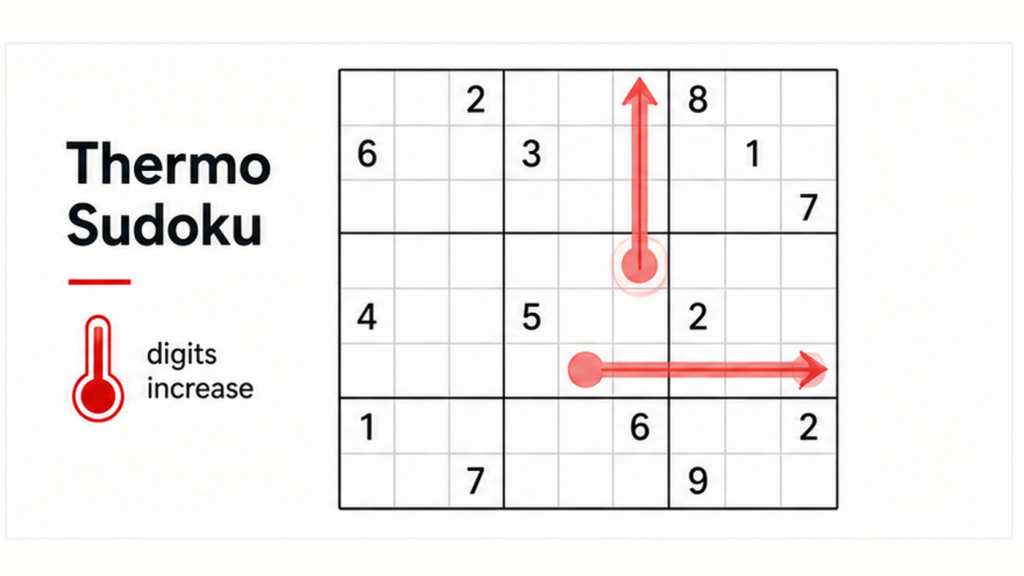
Learn Thermo Sudoku rules fast: digits increase from bulb to tip, values do not need to be consecutive, and long thermometers create range clues.
Want a better break than more reading?
Open a fresh Sudoku grid, keep the rules simple, and turn this article into actual practice.
Get the iPhone App →Thermo Sudoku adds one visual rule to a normal Sudoku grid: every thermometer must increase from the round bulb toward the tip. You still solve rows, columns, and 3×3 boxes with the digits 1 through 9, but each thermometer gives you extra range clues before you even write notes.
Use this guide to learn the Thermo Sudoku rules, spot the first deductions, and avoid the common mistake of treating thermometers as consecutive number runs. When you want to warm up with the same row-column-box logic, play Sudoku online on Pure Sudoku first.
Pure Sudoku
Practice the classic Sudoku rules first
Thermo puzzles still depend on ordinary Sudoku scanning. Start a fresh browser game, warm up your notes, then come back to the thermometer logic.
The Thermo Sudoku Rule in One Sentence
Digits on each thermometer must be strictly increasing as you move away from the bulb. Strictly increasing means each next cell is larger than the previous cell.
- A three-cell thermometer can be 1-4-9, 2-5-7, or 3-6-8.
- It cannot be 1-1-4, 4-3-8, or 7-8-8.
- The digits do not need to be consecutive unless the thermometer length forces them.
All normal Sudoku rules still apply. Every row, column, and 3×3 box must contain 1 through 9 exactly once.
How to Read a Thermometer
The round bulb is the low end. The tip is the high end. Every cell between them must climb in value, so position on the thermometer immediately gives you minimum and maximum ranges.
| Thermometer spot | What it tells you | Beginner deduction |
|---|---|---|
| Bulb | Must be lower than every later cell | Long thermometer bulbs are usually low digits |
| Middle cells | Must fit between earlier and later cells | Count cells before and after to set a range |
| Tip | Must be higher than every earlier cell | Long thermometer tips are usually high digits |
For example, the bulb of a five-cell thermometer cannot be 6, 7, 8, or 9, because there would not be enough larger digits left to complete the path. The tip of that same five-cell thermometer cannot be 1, 2, 3, or 4.
First Deductions to Make
A beginner Thermo Sudoku scan order
Start with the longest thermometers
Long thermometers have the tightest range limits. A six-cell thermometer forces the bulb into 1-4 and the tip into 6-9 before row or box logic is considered.
Mark low and high ranges
Count how many cells come before and after each position. A cell with two earlier thermometer cells must be at least 3. A cell with three later cells can be at most 6.
Combine with normal Sudoku
Once a thermometer range is small, check the row, column, and box. Ordinary solved digits often turn a broad range into one or two candidates.
Update the whole thermometer after every placement
If one cell is solved, every earlier cell must be lower and every later cell must be higher. Re-scan the full path immediately.
Simple Thermo Sudoku Example
Imagine a four-cell thermometer inside one box. Cell 1 is the bulb and cell 4 is the tip. If the second cell shares a row where 1, 2, and 3 are already used, that second cell cannot take those values. If the row also removes 4, the second cell must be at least 5.
That one fact pushes the bulb below 5 and pushes later cells above 5. This is the basic Thermo Sudoku rhythm: use the thermometer to define a range, then let classic Sudoku constraints shrink the range.
Classic Sudoku vs Thermo Sudoku
| Question | Classic Sudoku | Thermo Sudoku |
|---|---|---|
| Main rule | Rows, columns, and boxes contain 1-9 | Rows, columns, boxes, plus increasing thermometers |
| Best starting scan | Singles, boxes, rows, columns | Long thermometers, bulbs, tips, then normal scanning |
| Common beginner trap | Guessing too early | Assuming thermometer digits must be consecutive |
| Practice path | Start a fresh Sudoku game | Use classic logic, then add bulb-to-tip ranges |
Common Thermo Sudoku Mistakes
Thermometer values only need to go up. A path can jump from 2 to 5 to 9 if the row, column, and box rules allow it. The thermometer rule adds information; it does not replace rows, columns, or boxes. Use both systems together. Two-cell thermometers are flexible. Longer thermometers usually reveal the strongest first deductions. After any thermometer cell is solved, earlier cells lose high candidates and later cells lose low candidates.Mistake: assuming consecutive digits
Mistake: ignoring normal Sudoku
Mistake: starting with short thermometers
Mistake: not updating notes
How to Practice Thermo Logic
Pure Sudoku does not need a separate Thermo board to help you train the logic that makes Thermo puzzles easier. Use the free Sudoku browser game to practice scanning rows, columns, boxes, notes, and range thinking without downloads or signup.
- Warm up on Easy Sudoku if you are still learning clean candidate notes.
- Move to Hard Sudoku when you want stronger elimination practice.
- Use the Sudoku solving strategies guide when a thermometer range points to a hidden single, pair, or box-line reduction.
FAQ About Thermo Sudoku Rules
FAQ
- What is Thermo Sudoku?
- Thermo Sudoku is a Sudoku variant where thermometer shapes are drawn on the grid. Digits must increase from the bulb to the tip while still following normal Sudoku row, column, and box rules.
- Do Thermo Sudoku digits have to be consecutive?
- No. They only have to be strictly increasing. A thermometer can contain 2, 5, and 9, for example, as long as every later digit is larger than the previous digit.
- Where should beginners start in Thermo Sudoku?
- Start with the longest thermometers, then check bulbs and tips for low and high range limits. After that, combine those ranges with ordinary Sudoku scanning.
- Can numbers repeat on a thermometer?
- Not along the same thermometer path. Strictly increasing means the same number cannot appear twice on one bulb-to-tip path.
- Is Thermo Sudoku harder than regular Sudoku?
- Not always. Some Thermo puzzles are harder, but many feel more guided because the thermometers add useful range constraints.
Next Sudoku Variant Guides
Thermo Sudoku rewards the same disciplined scanning you use in classic puzzles. Keep practicing on Pure Sudoku, then compare other variants with Killer Sudoku rules, Hyper Sudoku rules, and Sudoku variations explained.
Related tools
Play Sudoku online
Keep the next step focused on a real Sudoku board.
Play Sudoku onlineHard Sudoku
Keep the next step focused on a real Sudoku board.
Hard SudokuSudoku strategies
Keep the next step focused on a real Sudoku board.
Sudoku strategiesGet a better Sudoku habit in your inbox
A quick daily puzzle reminder, streak motivation, and the occasional useful PS News update.