R1C1 Sudoku Notation Explained: Rows, Columns & Cells
R1C1 in Sudoku means row 1, column 1. Learn row-column notation, how to read solver coordinates, and how to name any Sudoku cell.
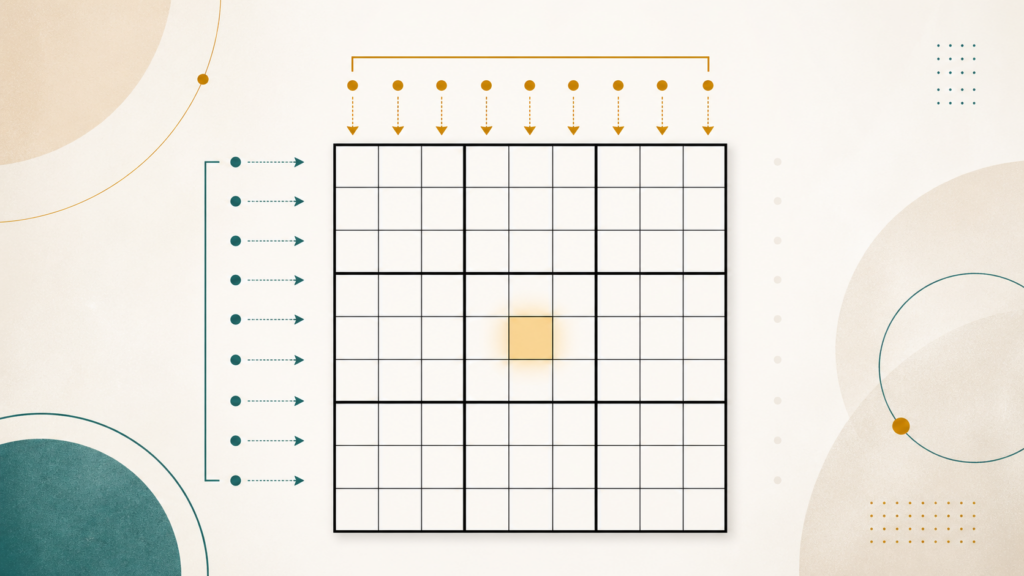
R1C1 in Sudoku means row 1, column 1, the top-left cell of the grid. Sudoku notation names any square by row first and column second, so r4c7 means row 4, column 7.
Coordinate practice Open a Sudoku board or solver, pick a square, and name its row and column until notation feels automatic.
Practice R1C1 notation on a real grid
Use this guide while you play Sudoku online in Pure Sudoku. Name a few cells during your next puzzle, then notation in strategy guides and solver explanations will stop feeling cryptic.
Quick Answer: What Does R1C1 Mean?
R1C1 means row 1, column 1. On a standard 9×9 Sudoku grid, rows are counted from top to bottom and columns are counted from left to right, so R1C1 is the top-left cell.
| Notation | Plain English | Grid location |
|---|---|---|
| r1c1 | row 1, column 1 | top-left cell |
| r5c5 | row 5, column 5 | center cell |
| r9c9 | row 9, column 9 | bottom-right cell |
| r4c7 | row 4, column 7 | fourth row, seventh column |
What Is Sudoku Notation?
Sudoku notation is a coordinate system for naming cells in a Sudoku grid. The most common format is rNcN, where the first number identifies the row and the second number identifies the column.
That makes written instructions precise. Instead of saying “the square near the middle on the right,” a strategy guide can say r5c8 and point to one exact cell.
How to Read Sudoku Coordinates
Read Sudoku notation in three steps
Find the row
In r6c3, start with row 6. Rows run horizontally and are counted from the top of the grid.
Find the column
Next find column 3. Columns run vertically and are counted from the left side of the grid.
Check the crossing cell
The square where row 6 and column 3 meet is r6c3. That is the only cell the coordinate names.
Why Sudoku Notation Matters
You can finish easy puzzles without naming cells, but notation becomes useful as soon as you read strategy guides, compare a move with a solver, or explain a placement to someone else.
- Tutorials become faster: you can jump directly to the cell being discussed.
- Solver output becomes readable: moves like r2c5 = 4 have a clear meaning.
- Technique examples become less vague: hidden singles, pairs, and eliminations can be shown without screenshots.
When a technique feels abstract, start a board in the free Sudoku browser game and translate each coordinate into a real square.
How Sudoku Solvers Use Notation
A Sudoku solver or walkthrough may output moves like these:
| Solver line | What it means |
|---|---|
| r2c5 = 4 | Place 4 in row 2, column 5. |
| remove 8 from r6c1 | 8 is no longer a valid candidate in row 6, column 1. |
| hidden single in row 8 at r8c3 | Only row 8, column 3 can take that digit. |
If you are checking a tough board, pair this notation guide with the Sudoku solver, then return to Pure Sudoku to solve the next board yourself.
Common Sudoku Notation Formats
rNcN format
This is the format most English-language Sudoku guides use. It is compact, search-friendly, and easy to scan in long solving explanations.
Written row-column format
Beginner guides sometimes spell the coordinate out as “row 4, column 7.” This is slower, but it helps when you are first learning.
Box or block references
Some explanations also mention boxes. For example, r5c8 belongs to the middle-right 3×3 box. Box references are helpful for eliminations, but row-column notation is still the exact cell address.
A Fast Practice Routine
Notation sticks faster when you use it on a real puzzle, not just in a table.
- Open Pure Sudoku and choose an easy board.
- Before each placement, say the coordinate out loud: “r3c4 gets a 9.”
- When you use notes, name one elimination: “remove 6 from r7c2.”
- After five to ten moves, read a strategy example and locate every referenced cell.
Pure Sudoku
CLEAN. SMART. ADDICTIVE.
Today's puzzle Today

Be the first to set a time today.
Prefer solo practice? Pick a difficulty to generate a fresh board instantly.
Pick the difficulty you want to race.
How do you want to play?
 00:00
00:00
 M: 0
M: 0
 81 remaining

Common Mistakes When Reading Sudoku Notation
Mixing up row and column order
Always read the row first. r4c7 is row 4, column 7, not column 4, row 7.
Counting from the wrong edge
Rows start at the top. Columns start at the left. Counting from the bottom or right gives the wrong cell.
Forgetting the surrounding box
Notation locates the square, but Sudoku logic still depends on checking the row, column, and 3×3 box around it.
What to Learn Next
Once R1C1 notation feels natural, move into beginner techniques that use exact cells. Start with Sudoku solving strategies, then practice one technique at a time in a fresh Sudoku game.
Keep learning
Play Sudoku online
Keep the next step focused on a real Sudoku board.
Play Sudoku onlineSudoku solver
Keep the next step focused on a real Sudoku board.
Sudoku solverDaily Sudoku
Keep the next step focused on a real Sudoku board.
Daily SudokuSudoku strategies
Keep the next step focused on a real Sudoku board.
Sudoku strategiesSudoku Notation FAQ
Sudoku Notation FAQ
- What does R1C1 mean in Sudoku?
- R1C1 means row 1, column 1. It is the top-left cell of a standard 9×9 Sudoku grid.
- What does r4c7 mean in Sudoku?
- r4c7 means row 4, column 7. Count four rows from the top, then seven columns from the left.
- What is the most common Sudoku notation format?
- The most common format is rNcN, where r stands for row and c stands for column.
- Do Sudoku solvers use row-column notation?
- Many solvers and walkthroughs use row-column notation because it is compact and points to exact cells.
- Is Sudoku notation only for advanced players?
- No. Beginners benefit from notation because it makes tutorials, examples, and solver explanations easier to follow.
Bottom Line
Sudoku notation is simple: read the row first, read the column second, then find the crossing cell. Once r1c1 stops looking cryptic, strategy articles and solver explanations become much easier to use.
To make it stick, start a fresh Sudoku game and name five moves by coordinate before you place them.
Sudoku Notation FAQ
Coordinate practice Try calling out row-column coordinates during your next puzzle so strategy guides and solver explanations are easier to follow.
Use notation while you solve