Arrow Sudoku Rules: Sum Arrows, Examples, and Mistakes
Arrow Sudoku rules are simple: the circle gives the total and the arrow cells must add up to it. Learn the quick rule, examples, common mistakes, and practice steps.
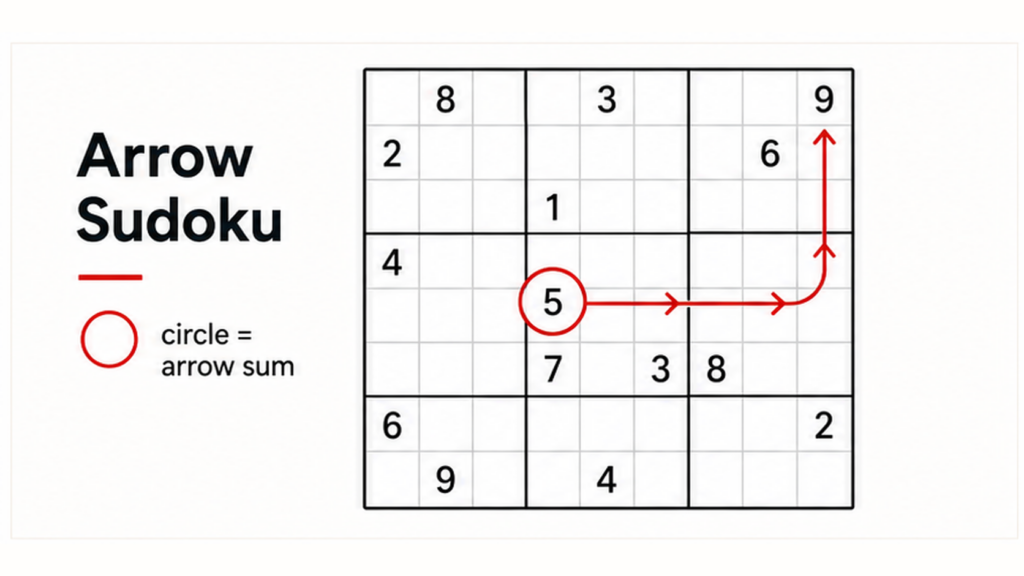
Arrow Sudoku has one extra rule: the circled digit is the total, and every digit on its arrow must add up to that circle. Normal Sudoku rules still apply, so each row, column, and 3×3 box must contain 1 through 9 exactly once.
This guide gives you the fast answer first, then walks through examples, beginner mistakes, and a clean practice path. If the sum clues feel crowded, play Sudoku online first and practice scanning rows, columns, boxes, and candidates before adding Arrow Sudoku constraints.
Arrow Sudoku Rules
Practice the Sudoku logic behind arrows
Start a fresh classic Sudoku game, turn on notes, and build the candidate skills that make Arrow Sudoku easier.
Arrow Sudoku Rules in 30 Seconds
- Fill the grid with digits 1 through 9.
- Each row, column, and 3×3 box must contain each digit once.
- Each circle gives a sum clue.
- The digits placed on the connected arrow path must add up to the digit in the circle.
- If an arrow has two cells and the circle is 9, the arrow cells must total 9.
- Digits may repeat on an arrow only when standard Sudoku rules allow it.
What Is Arrow Sudoku?
Arrow Sudoku is a Sudoku variation that adds circles and curved arrows inside the grid. The circle acts like a total, and the cells on the arrow must add up to that total.
Everything else stays the same as classic Sudoku. You still solve the puzzle with row, column, and box logic. The difference is that now every arrow creates an extra relationship between cells, which often makes the puzzle feel more logical and more constrained than a normal grid.
How Arrow Sudoku Works
The Circle Is the Total
The number in the circle tells you the total of the digits on that arrow. If the circle contains 7 and the arrow covers two cells, those two cells must add up to 7.
That means the only possible pairs are:
- 1 and 6
- 2 and 5
- 3 and 4
The Arrow Cells Must Add to the Circle
The cells on the arrow path are the ones that count toward the sum. Cells touching the curve but not part of the path do not matter. This sounds obvious, but it is one of the most common reading mistakes when a puzzle includes several overlapping arrows.
Standard Sudoku Rules Still Matter
The sum clue does not override normal Sudoku restrictions. If an arrow runs through three cells in the same row, those digits still cannot repeat. If two arrow cells sit in the same 3×3 box, those digits must also be different.
On the other hand, repeated digits can be legal on a longer arrow when those repeated digits are not in the same row, column, or box. The arrow rule only controls the total. Standard Sudoku rules still decide whether a repeated value is allowed.
Simple Arrow Sudoku Examples
Example 1: Circle 4 with Two Arrow Cells
If a circle shows 4 and the arrow contains two cells, the possibilities are very limited. The pair must be 1 and 3. A pair like 2 and 2 adds correctly, but it is usually illegal because the two cells often share a row, column, or box.
Example 2: Circle 6 with Three Arrow Cells
If three arrow cells must total 6, one useful starting set is 1, 2, and 3. Depending on where the arrow sits, other combinations can also be possible, but the clue is still small enough that you should immediately test which combinations survive row, column, and box restrictions.
Example 3: Large Circle Value
If a circle is 9 and the arrow has two cells, you can think in complementary pairs: 1+8, 2+7, 3+6, or 4+5. Then remove any pair blocked by the rest of the grid.
Best First Steps When You Start an Arrow Sudoku
1. Look for Short Arrows
Short arrows are the easiest clues to evaluate. Two-cell arrows and three-cell arrows usually narrow faster than long winding arrows because the total creates fewer realistic combinations.
2. Look for Very Small or Very Large Totals
A small circle value like 3, 4, or 5 usually forces a tight set of digits. A large value on a short arrow does the same thing. These are the clues that give you the fastest eliminations early in the puzzle.
3. Combine Sum Logic with Sudoku Logic
Do not treat the arrow as a math puzzle by itself. The real progress comes from combining the sum with the row, column, and box restrictions around it. Often an arrow leaves two or three possible combinations, and the surrounding house structure eliminates the rest.
4. Use Pencil Marks Carefully
Arrow Sudoku gets much easier when your candidates are clean. If you already use notation in classic Sudoku, keep doing it here. The difference is that each arrow gives you a quick way to compare candidate sets across several cells at once.
Arrow Sudoku Solving Tips That Actually Help
Think in Combinations, Not Equations
You usually do not need advanced arithmetic. What you need is a short list of legal combinations. For example, a three-cell arrow totaling 7 does not require every possible sum in your head. You mainly need the small family of combinations that can make 7, then you check which ones fit the grid.
Watch the Circle Cell as a Constraint
The circled cell is not just an answer box. It also behaves like a normal Sudoku cell inside its row, column, and box. If the circle can only be 8, then the arrow must total 8. If the arrow cells can only total 6 or 7, you know something is wrong in your candidates.
Use Box Structure to Cut Options Fast
Many arrows stay partly inside one box or cross from one box into another. That matters because box restrictions often remove duplicate-heavy combinations immediately. A sum that looks flexible on paper may become very tight once you notice that two arrow cells share the same 3×3 box.
Do Not Overfocus on One Arrow
A common beginner mistake is trying to finish one arrow before looking elsewhere. Arrow Sudoku usually solves best when you move between clues. One arrow limits a box, that box fixes a row, and that row then resolves another arrow.
Common Arrow Sudoku Mistakes
Forgetting That Classic Sudoku Rules Still Apply
This is the biggest one. Players sometimes allow a repeated digit on an arrow because the math works, even when the cells share a row, column, or box. If the placement breaks standard Sudoku rules, it is not valid.
Counting the Wrong Cells
Only the cells on the arrow path count toward the total. Check the exact curve, especially when several arrows cross visually.
Assuming Every Sum Has Many Options
Some totals are much more restrictive than they look. A short arrow with a low or high total often has only a tiny set of valid combinations.
Ignoring the Circle as a Candidate Cell
The circled cell is still part of a row, column, and box. If you solve or restrict that cell, the whole arrow becomes easier.
Practice Classic Sudoku First
Arrow Sudoku is easier when your classic solving habits are automatic. Use the free Sudoku browser game to practice clean notes, hidden singles, and box scanning before you add sum clues.
Pure Sudoku
CLEAN. SMART. ADDICTIVE.
Today's puzzle Today

Be the first to set a time today.
Prefer solo practice? Pick a difficulty to generate a fresh board instantly.
Pick the difficulty you want to race.
How do you want to play?
 00:00
00:00
 M: 0
M: 0
 81 remaining

Is Arrow Sudoku Harder Than Classic Sudoku?
Usually, yes, but not because the rules are complicated. Arrow Sudoku adds another layer of logic, so there are more relationships to track. The upside is that the clues are often clean and fair. Many players find Arrow Sudoku easier to enjoy than some advanced classic techniques because the logic is visible on the grid.
Arrow Sudoku vs Thermo Sudoku
Arrow Sudoku and Thermo Sudoku both add visual paths to the grid, but the rule is different:
- In Arrow Sudoku, the digits on the path must add up to the circle.
- In Thermo Sudoku, digits must increase from the bulb to the tip.
If you enjoy one, you will probably enjoy the other, but the solving mindset changes. Arrow Sudoku is about sum combinations. Thermo Sudoku is about strict order.
Arrow Sudoku FAQ
Arrow Sudoku Rules FAQ
- What are the rules of Arrow Sudoku?
- Normal Sudoku rules apply, and each circled cell gives the sum of the digits along its connected arrow. The arrow cells must add up to the circle value.
- Can digits repeat on an arrow in Arrow Sudoku?
- Sometimes, yes, but only if the repeated digits do not break standard Sudoku rules. If two arrow cells share a row, column, or box, they still must be different.
- Do you need math tricks for Arrow Sudoku?
- No. Basic addition is enough. The real skill is spotting which combinations fit the row, column, and box restrictions.
- What is the best way to start an Arrow Sudoku puzzle?
- Start with the shortest arrows and the most extreme totals. Those clues usually produce the fastest eliminations.
- Is Arrow Sudoku good for beginners?
- Yes, if you already understand normal Sudoku rules and simple pencil marks. Practice classic Sudoku first, then add the arrow sum rule once scanning feels comfortable.
Final Take
The core arrow sudoku rules are simple: the circle equals the sum of the digits on its arrow, and the rest of the puzzle still follows standard Sudoku logic. Once you stop reading it as a strange math puzzle and start treating it as normal Sudoku plus one extra constraint, the variation becomes much easier to solve.
If you want to build from here, compare this variation with Thermo Sudoku Rules, Diagonal Sudoku Rules, and Jigsaw Sudoku Rules. Then start a fresh Sudoku game and practice spotting the shortest constraints first.
Keep practicing
Play Sudoku online
Keep the next step focused on a real Sudoku board.
Play Sudoku onlineSudoku strategies
Keep the next step focused on a real Sudoku board.
Sudoku strategiesDaily Sudoku
Keep the next step focused on a real Sudoku board.
Daily Sudoku